
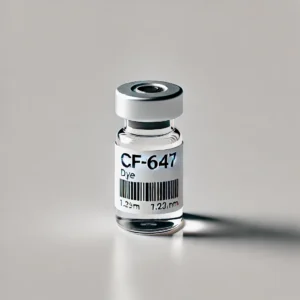
The CF®647 Dye 1mg IgG Labeling Kit is a state-of-the-art tool specifically engineered for labeling IgG antibodies with exceptional efficiency and precision. Its advanced design caters to the most demanding research applications, including immunofluorescence, flow cytometry, and live-cell imaging. The kit has gained significant traction among researchers due to its robust performance and ease of use.
This article provides a comprehensive exploration of the technical attributes, diverse applications, and unparalleled benefits of the CF®647 Dye Labeling Kit, supported by insights from top-tier scientific and governmental resources.

In-Depth Technical Features of CF®647 Dye
1. High Signal-to-Noise Ratio
The CF®647 Dye delivers bright fluorescence with minimal background interference, enabling researchers to distinguish signals with exceptional clarity. This feature is especially valuable for analyzing rare populations in flow cytometry. Read about fluorescence optimization at the NIH Flow Cytometry Core.
2. Advanced Compatibility with Laser Systems
Designed to be compatible with the 633 nm or 647 nm laser excitation lines, CF®647 Dye integrates seamlessly into standard and advanced imaging platforms. Learn more about laser compatibility in research at the National Science Foundation.
3. Reduced Photobleaching
The photostability of CF®647 minimizes signal degradation during long imaging sessions, a critical advantage in super-resolution microscopy. Detailed microscopy techniques can be found at MicroscopyU.
4. High Molar Extinction Coefficient
The dye’s outstanding extinction coefficient ensures excellent brightness, even at low concentrations. This is particularly beneficial for applications involving limited sample quantities. Explore spectral efficiency guidelines at the National Cancer Institute.
5. Minimal Aggregation
CF®647 Dye demonstrates low aggregation tendencies, reducing nonspecific binding and improving experimental reproducibility. Further details on antibody labeling protocols are available at the National Institutes of Standards and Technology.
Enhanced Applications of CF®647 Dye
1. Tissue Imaging
The dye’s long-wavelength emission penetrates deep into tissues, making it ideal for whole-tissue imaging in immunohistochemistry. Explore tissue imaging insights at the Human Protein Atlas.
2. Super-Resolution Microscopy
CF®647 is compatible with structured illumination and stimulated emission depletion (STED) microscopy, enabling nanoscale resolution. Review super-resolution methodologies at NIH STED Microscopy Resources.
3. Multiplexed Assays
The spectral distinctiveness of CF®647 Dye facilitates multiplex assays involving multiple fluorophores. Learn about multiplex assay development at the National Center for Advancing Translational Sciences.
4. Quantitative Flow Cytometry
The dye enables precise quantitation of antigen expression levels in cellular populations. Guidance on flow cytometry quantitation is available at the CDC.
5. Intracellular Staining
Its superior penetration and low toxicity make CF®647 Dye ideal for intracellular antibody staining. Details on intracellular staining can be found at PubMed Central.

Benefits Tailored for Modern Research
1. Accelerated Conjugation Process
The kit’s streamlined protocol minimizes hands-on time, enabling researchers to complete labeling in less than an hour. Review step-by-step instructions at NIST Protocols.
2. Optimal Antibody Retention
The dye binds to IgG antibodies without compromising their functional integrity, ensuring reliable antigen detection. Learn about antibody preservation techniques at the FDA Antibody Guidance.
3. Scalability for High-Throughput Studies
The CF®647 Dye Labeling Kit is optimized for both small-scale experiments and high-throughput workflows. Explore scalable research designs at NIH High-Throughput Facilities.
4. Sustainable and Eco-Friendly
The dye synthesis process follows environmentally conscious guidelines, reducing the use of hazardous chemicals. Review eco-friendly laboratory practices at EPA Green Chemistry.
Practical Considerations for Researchers
- Storage Stability: The kit components are stable at recommended storage conditions for over 12 months. Find storage guidelines at NIH Biospecimen Research.
- Labeling Efficiency: Achieve over 90% labeling efficiency with minimal loss of antibody activity. More technical insights are available at PubMed.
- Spectral Compatibility: The emission profile is well-suited for most commercial filters, as detailed by Fisher Scientific Spectral Data.
References and Further Reading
For detailed information and related studies, consider the following resources:
- NIH Research Tools: Comprehensive guides on labeling dyes and imaging (nih.gov).
- U.S. Department of Energy: Insights into photonic applications (energy.gov).
- NSF Science Funding: Grant opportunities and fluorescent labeling research (nsf.gov).
- CDC Laboratory Practices: Best practices in molecular diagnostics (cdc.gov).
- FDA Regulatory Compliance: Guidelines for fluorescent labeling kits (fda.gov).
By leveraging the CF®647 Dye 1mg IgG Labeling Kit, researchers can achieve unprecedented precision and reliability in fluorescent antibody labeling, paving the way for breakthrough discoveries. For technical support or additional resources, visit trusted platforms such as the National Library of Medicine or the Human Proteome Project.