
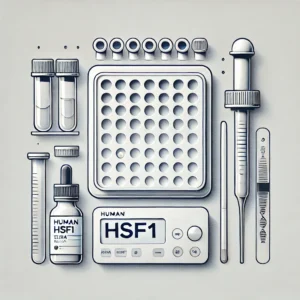
The Human HSF1 (Heat Shock Factor 1) ELISA Kit is a highly specific and sensitive assay for the detection and quantification of HSF1 in biological samples such as serum, plasma, and cell culture supernatants. HSF1 is a key transcription factor that regulates the expression of heat shock proteins (HSPs) in response to cellular stress. It plays a pivotal role in maintaining cellular homeostasis, protecting cells from stress, and modulating various physiological and pathological processes, including cancer, neurodegenerative diseases, and inflammation.
What is Heat Shock Factor 1 (HSF1)?
HSF1 is a master regulator of the heat shock response. In normal conditions, it remains inactive, but upon stress, it becomes activated and binds to heat shock elements (HSEs) in the promoter regions of heat shock protein genes, driving their expression. These proteins help in folding misfolded proteins, preventing aggregation, and enhancing cell survival under stress.
For detailed insights into HSF1’s structure and function, visit PubMed or the National Center for Biotechnology Information (NCBI).

Clinical Significance of HSF1
1. Cancer
HSF1 is overexpressed in many types of cancer, where it promotes tumor growth and metastasis by supporting protein synthesis and suppressing apoptosis. It is a potential target for cancer therapy. For more details, visit the National Cancer Institute (NCI).
2. Neurodegenerative Diseases
HSF1 has been implicated in the protection against neurodegenerative disorders such as Alzheimer’s disease and Parkinson’s disease, where it regulates the expression of proteins that prevent aggregation of misfolded proteins. Learn more at NIH Neuroscience Research.
3. Inflammatory Disorders
HSF1 modulates inflammatory responses by regulating the expression of pro-inflammatory cytokines. This role is critical in diseases like autoimmune disorders and chronic inflammation. Find resources at National Institute of Allergy and Infectious Diseases (NIAID).
Applications of the Human HSF1 ELISA Kit
The Human HSF1 ELISA Kit is a versatile tool used in both research and clinical settings:
1. Cancer Research
The kit is used to study the role of HSF1 in cancer progression, metastasis, and therapy resistance. It also aids in exploring HSF1 as a potential target for cancer treatment. For cancer research guidelines, visit AACR.
2. Neurodegenerative Disease Studies
Researchers use the kit to measure HSF1 levels and its activation in neurodegenerative disorders, helping in the development of therapeutic strategies. Explore more at Alzheimer’s Association.
3. Stress and Inflammation Research
The kit supports studies investigating HSF1’s role in cellular stress responses and its involvement in regulating inflammation and immune responses. Learn more at Science.gov.
4. Drug Development
HSF1 is a promising therapeutic target. The kit helps evaluate the effects of small molecules or drugs modulating HSF1 activity. Details about drug development can be found at ClinicalTrials.gov.
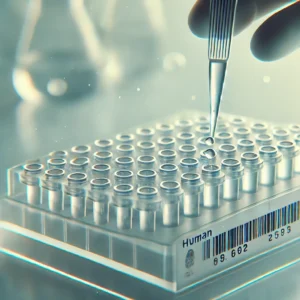
Features of the Human HSF1 ELISA Kit
- High Sensitivity and Specificity: Detects low levels of HSF1 with minimal cross-reactivity.
- Wide Dynamic Range: Suitable for detecting a broad range of HSF1 concentrations.
- User-Friendly Protocol: Includes pre-coated plates and ready-to-use reagents for easy and efficient assays.
- Sample Compatibility: Validated for use with serum, plasma, and cell culture supernatants.
- Quantitative Results: Provides accurate and reproducible measurements of HSF1 levels.
How the Human HSF1 ELISA Kit Works
The enzyme-linked immunosorbent assay (ELISA) uses antigen-antibody interactions to detect specific proteins. The process for the HSF1 ELISA Kit involves:
- Capture: The microplate is pre-coated with an antibody specific to HSF1.
- Sample Addition: Biological samples containing HSF1 are added to the plate, allowing the protein to bind to the capture antibody.
- Detection: A biotin-conjugated detection antibody binds to the captured HSF1.
- Signal Amplification: Streptavidin conjugated to an enzyme reacts with a substrate to produce a colorimetric signal proportional to the HSF1 concentration.
- Quantification: The optical density is measured, and HSF1 levels are quantified against a standard curve.
For more technical details, refer to the NIH Assay Guidance Manual.
Advantages of the Human HSF1 ELISA Kit
- Fast Turnaround Time: Results are available within 2-3 hours.
- High Throughput: Supports the simultaneous analysis of multiple samples.
- Reproducibility: Ensures consistent results across experiments.
- Cost-Effective: Provides a robust and affordable alternative to other protein detection methods like Western blotting or mass spectrometry.
Challenges and Future Directions
1. Standardization
Variability in sample handling and assay conditions may affect results. Standardized protocols are essential for consistent outcomes. Guidelines for assay standardization are available at NIST.
2. Emerging Technologies
Techniques like proteomics and multiplex assays are being developed to complement ELISA and enhance biomarker discovery. Learn more at NIH Proteomics Research.
3. Therapeutic Targeting
Expanding HSF1’s application as a diagnostic and therapeutic target in clinical settings remains a priority. Explore ongoing research at NIH Translational Research Resources.
Conclusion
The Human HSF1 ELISA Kit is an indispensable tool for advancing research in cancer, neurodegenerative diseases, inflammation, and stress response. Its ability to accurately and quantitatively measure HSF1 levels supports the development of novel diagnostics and therapeutics, ultimately improving patient care.
For further resources, visit:
- Harvard Medical School Research Labs
- Johns Hopkins University Biomedical Research
- Mayo Clinic Research Laboratories
If you’d like accompanying images for this article, let me know!